
The Essential AI Co-Pilot for Business Owners in 2026: Staying Ahead in the Evolving AI Landscape
Erika Williams
12/12/20255 min read

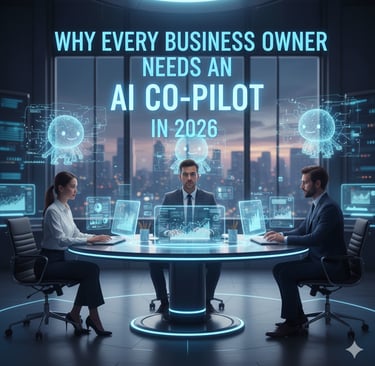
Understanding the AI Revolution
The rapid evolution of artificial intelligence (AI) over the past decade has begun to fundamentally alter the landscape of business operations across various sectors. As AI technologies continue to mature, they increasingly foster enhanced operational efficiency, drive innovation, and create new market opportunities. The implications of these advancements are profound, making it paramount for business owners to stay informed and adapt to this shifting paradigm to maintain competitiveness.
Recent trends indicate a marked acceleration in AI adoption, propelled by advancements in machine learning algorithms, natural language processing, and data analytics. Enterprises are leveraging these technologies to automate repetitive tasks, analyze vast datasets for actionable insights, and personalize customer experiences. This utilization of AI not only saves time and resources but also allows organizations to focus on strategic initiatives that can lead to growth and development.
Looking ahead to 2026, we can expect several significant milestones in AI capabilities. For example, the integration of AI with other emerging technologies, such as blockchain and the Internet of Things (IoT), is likely to create even more sophisticated systems that facilitate real-time decision-making and enhance supply chain efficiency. Pay attention to AI's expanding role in predictive analytics, which can enable businesses to forecast trends and customer behaviors with unprecedented accuracy.
Moreover, the ethical considerations surrounding AI usage are becoming increasingly important. As businesses incorporate AI into their operations, understanding bias, data privacy, and algorithm transparency will be vital in fostering trust with consumers. The evolution of AI cannot be merely viewed as a technological shift; it is also a cultural and societal transition that demands responsible practices.
Embracing the AI revolution involves a proactive stance towards learning and adapting to emerging technologies. Business owners must prioritize continuous education on these advancements to harness AI's full potential while ensuring their organizations remain agile and competitive in an ever-evolving landscape.
The Benefits of an AI Co-Pilot
In the rapidly evolving business landscape of 2026, incorporating an AI co-pilot into a business strategy can yield substantial advantages. One of the primary benefits lies in enhanced decision-making assistance. AI co-pilots process vast amounts of data quickly, providing insights that are critical for informed decision-making. By leveraging machine learning algorithms, these systems can analyze historical trends and current market conditions, making it easier for business owners to navigate potential challenges and capitalize on opportunities.
Furthermore, an AI co-pilot excels in data analysis. Businesses today generate immense amounts of data, often rendering manual analysis impractical. AI co-pilots streamline this process by detecting patterns, identifying anomalies, and generating actionable reports. This capability not only saves time but also allows even smaller businesses to compete based on data-driven insights that were previously accessible only to larger corporations. With the right AI tools, entrepreneurs can turn data into a strategic asset, enhancing overall operational efficiency.
Another valuable benefit of an AI co-pilot is its role in customer service enhancement. By integrating AI technologies like chatbots and virtual assistants, companies can offer 24/7 support, ensuring that customer queries are addressed promptly. This level of engagement improves customer satisfaction and retention, which are vital for long-term success. In some cases, businesses have reported significant improvements in customer feedback scores after adopting AI-assisted service solutions.
Lastly, predictive analytics powered by AI provides a competitive edge in anticipating market trends. For instance, utilizing AI to forecast sales trends or customer behavior helps businesses strategize effectively. Companies like Amazon have demonstrated the power of predictive analytics, allowing them to stay ahead of the curve by accurately forecasting demand and adjusting inventory accordingly. Through these varied applications, it's clear that an AI co-pilot is not just an innovative tool—it is becoming an essential component for growth in contemporary business operations.
Navigating Challenges in AI Adoption
The integration of artificial intelligence (AI) within business operations is inherently fraught with challenges that can complicate adoption. Among these obstacles, cost concerns often emerge as a primary barrier. Either the upfront investment required for AI technologies can be considerable, or businesses may struggle to identify the long-term return on this investment. To mitigate financial risks, owners should conduct thorough cost-benefit analyses and explore scalable AI solutions that can adapt with the growth of their organizations.
Data privacy issues present another significant hurdle. As businesses harness AI to process vast amounts of data, ensuring compliance with regulations such as GDPR becomes essential. Business owners must implement robust data governance strategies and seek AI tools that prioritize security and transparency, thereby establishing trust both internally and externally.
Employee resistance often complicates the adoption of AI technologies. Workers may fear for their jobs or feel unprepared to engage with new systems. To overcome this resistance, businesses should foster a culture of collaboration by communicating the benefits of AI clearly to their teams. It is vital to involve employees in the transition process and emphasize how AI serves as a supportive co-pilot rather than a direct replacement for human roles.
Moreover, the necessity of ongoing training cannot be overlooked. Continuous education and skills development are crucial to empower employees to utilize AI effectively. By providing targeted training programs, companies can help their workforce become adept at using AI tools. Choosing the right AI technologies that seamlessly integrate into existing workflows is equally important, as this ensures smoother transitions.
In crafting a strategic approach to adopting AI, business owners can navigate these challenges effectively. Through careful planning, investment in workforce training, and a commitment to robust data practices, organizations can fully capitalize on AI's transformative potential while minimizing disruptions.
Preparing for the Future with AI
As we move closer to 2026, business owners must recognize the imperative to prepare for an evolving AI landscape that promises substantial innovation and disruption. Embracing a proactive mindset is critical; this includes engaging in continuous learning to stay informed about the latest technological advancements in artificial intelligence. Business owners should actively seek out educational resources such as industry conferences, webinars, and online courses that focus on AI trends and applications. Such initiatives will not only enhance their understanding but also encourage adaptive thinking, crucial in an era characterized by rapid change.
Additionally, investing in synthetic intelligence products emerges as a significant strategy for future readiness. As AI technologies become more sophisticated and integrated into business operations, entrepreneurs must consider the tools that will support their specific needs. Identifying and implementing AI solutions that align with organizational objectives can enhance efficiency and decision-making capabilities. Furthermore, establishing a strong collaboration with AI vendors and consultants can provide tailored insights that facilitate effective integration of AI into existing workflows.
Business owners should also envision the evolution of their AI co-pilot. This requires a strategic approach wherein they define clear goals for AI's role within their organization. By setting long-term objectives, owners can ensure that their AI initiatives remain aligned with overall business strategies. Adapting to changes in technology and market demands will necessitate regular reviews of AI systems, facilitating enhancements and optimizations over time.
In conclusion, preparing for the future with AI demands a concerted effort focused on learning, investment, and strategic planning. By taking these steps, business owners can leverage artificial intelligence as a core component of their strategic vision, ensuring they not only keep pace with the evolving landscape but also thrive within it.
Tell me a little about where you’re at, and I’ll guide you to the best next step.
Address
55 Houghton Drive, Carramar, WA 6031
Contacts
+61448037387
erika@erikawilliams.com.au
What Happens Next?
I’ll review your message personally
If it’s a fit, I’ll suggest the best next step
No pressure. No sales scripts. Just clarity